
Natural Resources Research & Management
Natural Resources Research & Management
Woods to Water is an experience-based post-baccalaureate training program aimed at helping early career scientists understand critical linkages between terrestrial and aquatic ecosystems. Over a 12-month period, participants will be introduced to standardized field techniques and data collection, conduct an independent study with a research mentor, and present a research poster at the program’s end. Funding was provided by a National Science Foundation Research and Mentoring for Postbaccalaureates (NSF RaMP) grant to The University of Alabama and The Jones Center at Ichauway in partnership with NSF’s National Ecological Observatory Network (NEON).
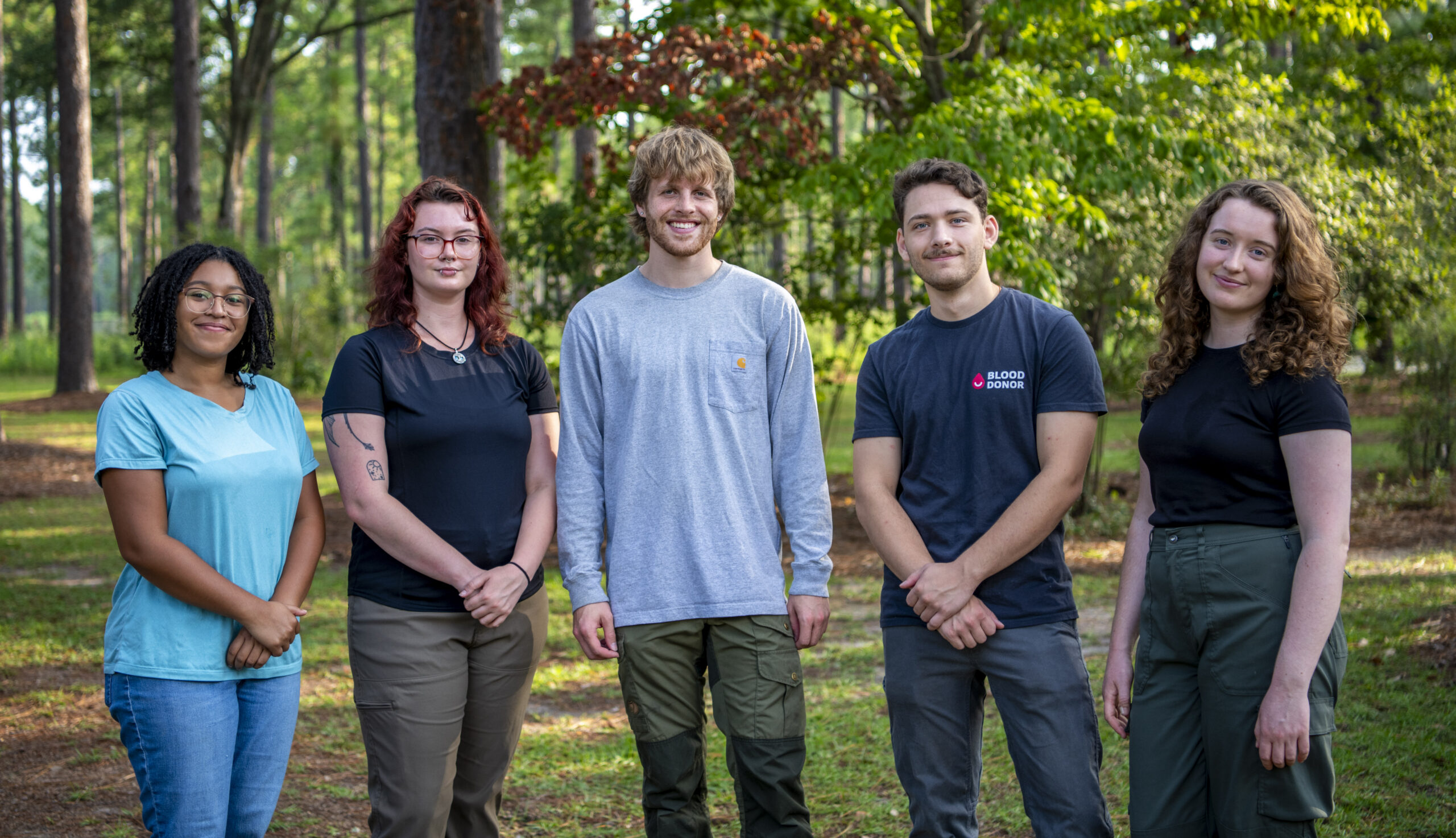
This fall, we welcomed a new cohort of Woods to Water RaMP fellows to Ichauway. These early-career scientists will spend the next six months working alongside our staff, obtaining direct field and laboratory research experience while learning more about the natural resources of the Dougherty Plain of southwest Georgia. This cohort’s fellows are Leah Saunders, Sarah Mitchell, Andrew Buckland, Jacob Holland, and Elizabeth Ward.
During their time at Ichauway, each fellow will work alongside Jones Center scientists in several research areas. Leah Saunders will work alongside Dr. Jeffery Cannon and Leah Andino in our Landscape Ecology Lab; Sarah Mitchell will work alongside Dr. Savanna Wooten, Dr. Nick Marzolf, and Jamie Rogers in our Aquatic Sciences Lab; Andrew Buckland and Jacob Holland will work alongside Dr. Steven Brantley and Emma Marzolf in our Ecohydrology Lab; and Elizabeth Ward will work alongside Dr. David Mason and Lisa Giencke in our Plant Ecology Lab. Learn more about each fellow below:
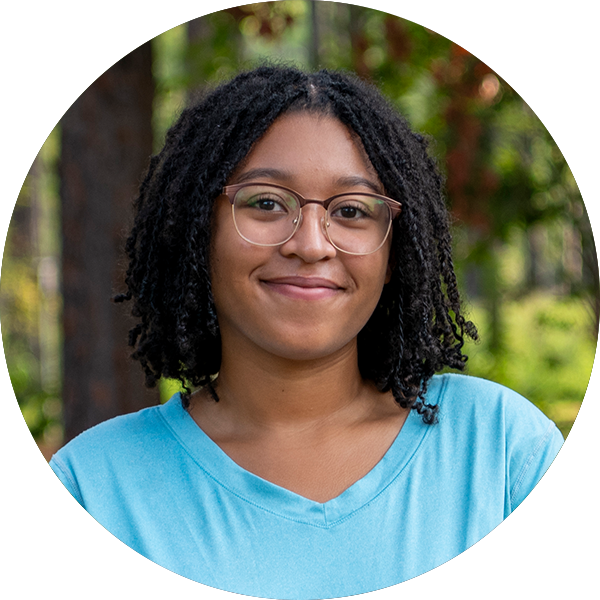
Leah Saunders – I’ve lived in Lebanon, Ohio, my entire life. I attended Tuskegee University, where I earned my bachelor’s degree in environmental science. During my undergraduate studies, I participated in two summer internships and a long-term fellowship, where I worked with a professor doing soil microbial work.
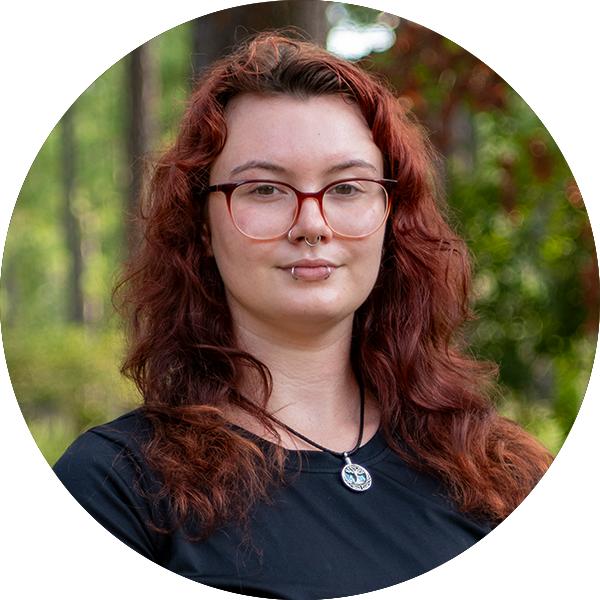
Sarah Mitchell – I completed my undergraduate studies at the University of Alabama, where I earned a bachelor’s degree in biology. I’m originally from Mobile, Alabama, and I’m interested in aquatic ecology, particularly aquatic systems and wetlands. I’m also passionate about environmental justice.
Before joining the Woods to Water program, I did not have much research experience. I completed two capstone projects, one of which involved conducting a literature review. I also briefly worked in the Alabama Stable Isotope Lab, where I helped run equipment and assisted a Ph.D. student with DNA extractions, PCRs, and pigment extractions.
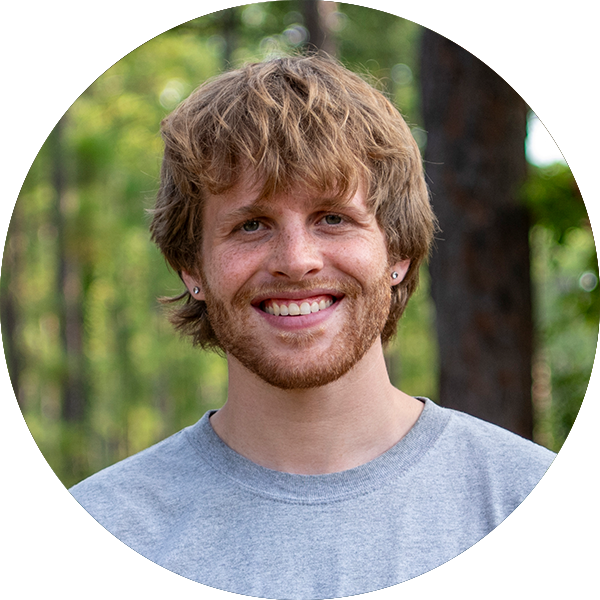
Andrew Buckland – I was born and raised in Lehi, Utah, and recently earned a B.S. in Computer Science from Utah Valley University. Before joining the Woods to Water program, I gained experience in ecology through establishing the Cooks Branch Forest Dynamics Plot, a ForestGEO research site. Prior to this, most of my experience has been in data science, programming, and math.
I enjoy exploring ecosystems, camping, reading, and playing guitar.
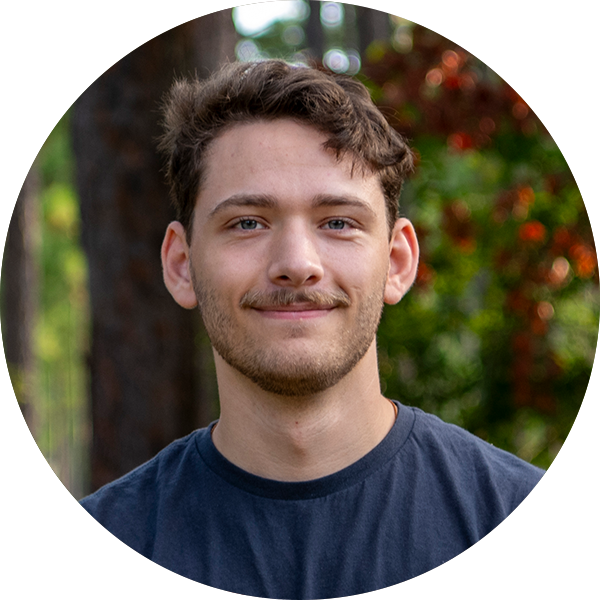
Jacob Holland – I was born and raised in Madison, Alabama, where I developed my first relationship with nature as a recipient of clean air to breathe, tall trees to climb, and plenty of dirt to roll in. Time passed and my relationship with nature evolved as I came to understand the threats the environment is facing on a global and local scale from the actions of humanity.
I attended Auburn University, where I earned a B.S. in Environmental Science in hopes of gaining the skills and knowledge needed to study and preserve the environment. While at Auburn, I also reignited a once dormant interest in soils through my participation on the Soil Judging Team and my work in a soil fertility/conservation lab.
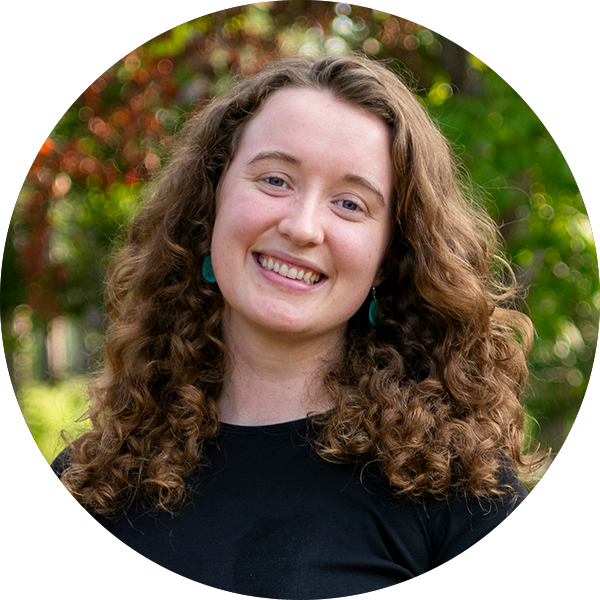
Elizabeth Ward – I was actually an English major for most of my college career, so I am relatively new to science and research! After taking a break from school to determine what I truly wanted to do, I re-entered college at San Francisco State University as a biology major with a concentration in Ecology, Evolution, and Conservation.
I’m from Oakland, California, so it has been really exciting to learn about the organisms and natural systems I grew up around. I am really interested in vertebrate biology and interactions between organisms, although much of my research experience has focused on extremophile microorganisms in terrestrial hot springs. My advisor often teased me that I only liked charismatic megafauna!
I have always loved outdoor recreation – I go hiking and camping often when I’m back home. So, when I entered my senior year of high school and was unsure of what major to pursue, I found environmental science. The idea of studying the nature around me that I loved so much immediately drew me to environmental programs.
Honestly, a movie sparked my interest in ecology and conservation. I watched Erin Brockovich during my sophomore year, and it brought my attention to environmental justice. From my literature review, I discovered that quite a bit of environmental injustices come from disturbances in the systems around people, meaning that conservation, and even restoration, is needed to help impacted communities. My interest only grew when I took a wetland ecology course and learned how much these systems provide, and how many of them have already been lost.
My interest in ecology came from exploring the wide variety of ecosystems that are present in Utah. Whether I was hiking through wetlands of the Uinta Mountains, the alpine zones of the Wasatch Range, or the red rock deserts of Canyonlands National Park, my curiosity has always been piqued by the innumerable processes and organisms that were unknown to me. Answering these questions and finding a way to actively conserve these ecosystems is what drove me toward the field of ecology.
It was fear. I remember it distinctly. As a kid, I was watching an old children’s science show called Beakman’s World, and one episode included a segment about ozone depletion. The idea that the environment could collapse from human actions was terrifying. As with any other fear, I had two options: I could hide it away and repress it, or I could confront it and do something.
Eventually, I chose the latter, and I sought out knowledge of the environment and its many ecosystems. I hope to one day play my part in addressing those issues and help create a future where everyone can enjoy the freedom of clean air and water.
There is so much diversity and beauty in the natural world, and I think I have always been fascinated by what was around me and how different organisms interacted with each other.
My interest in conservation grew once I realized that many of the biological systems I admired were under incredible threat! The idea that something could evolve for thousands or even millions of years, becoming perfectly adapted to its environment, and then disappear because people did not recognize its value was devastating to me. Understanding the world around me and conserving it for the benefit of all the organisms that live here, humans included, is a huge motivation.
I am most looking forward to developing my field research skills, as a lot of my previous experience is from working in a lab. I’m also excited to learn more about Alabama and Georgia’s native wildlife and plant species! After completing the program, I hope to pursue my master’s degree in a related natural science field.
I am most looking forward to learning how to conduct my own research. I can’t wait to gather data and get hands-on experience with things I have previously only had the opportunity to learn and read about.
After completing the program, I would like to either attend graduate school or enter the workforce with a nonprofit organization. This program will help me decide which I would want to do first.
I am most looking forward to learning the links between terrestrial and aquatic ecosystems. Learning about the hydrology of the systems we will be working in will also give me useful skills that I can carry with me for the rest of my life.
After completing the program, my goal is to have a clearer idea of what direction I want to pursue next. I want to attend graduate school, but it is important that I determine my field of research before finding a program.
I am looking forward to learning from experts across a variety of fields and gaining firsthand experience in scientific research outside of my previous specialization. Of course, that isn’t to say all I am excited about is academic in nature, I’m also excited for the opportunity to work and live in one of Alabama’s last few longleaf pine habitats.
I am really looking forward to getting my feet wet with fieldwork! The organisms and ecosystems of the Southeastern United States are totally different from what I am used to, so I’m excited to learn about ecosystems that are completely new to me.
One of my goals after completing the program is to attend graduate school, but I have a wide range of interests. I’m hoping the Woods to Water program will help me determine what I really want to study and what the best path and programs will be for me moving forward.
A book I would recommend is Into the Wild by Jon Krakauer.
I think every ecologist would consider Silent Spring by Rachel Carson, a must-read. As for science in general, I really love the podcast called Ologies by Alie Ward. She has many different scientists from a variety of fields come and talk about what they do and their research.
One podcast that I have found interesting is Crime Pays But Botany Doesn’t. The creator who started the podcast is a botanist who has a YouTube channel.
I would recommend J.R.R. Tolkien’s The Lord of the Rings: The Two Towers. To me, it contains a beautiful message about the strength of nature and the necessitation of action in the face of uncaring and destructive forces against it. The series is a fantastic mix of both fantasy and environmental grandeur. Tolkien depicts the beauty of the world and the horror of its destruction all while providing a coherent and emotional narrative.
On a more traditional environmental note, Rachel Carson’s Silent Spring is another must-read. As a result of Carson’s book, Earth Day was born and real action was achieved limiting the use of the pesticide, DDT. Because of the book’s success, DDT is no longer a major threat.
I don’t know if it is exactly a must-read, but a very fun and interesting book is Bitch: On the Female of the Species by Lucy Cooke. I took a lot of gender studies classes when I was an English major, so this book pulls a lot of my interdisciplinary interests together!
It is about the science of evolution and sex, and while humans have their own ideas about what is “correct” in terms of biological sex and gendered behavior, clownfish change sexes, orcas are matriarchal, and female pinyon jays wage vicious dominance fights! It is interesting to think about what we might be missing due to our own biases and to learn more about the evolution of different traits in “the female animal.”