
Natural Resources Research & Management
Natural Resources Research & Management
The Aquatic Sciences Lab at The Jones Center at Ichauway has been busy this spring and summer collaborating on a pilot study investigating the movement and spawning dynamics of Alabama Shad (Alosa alabamae) in the lower Apalachicola-Chattahoochee-Flint (ACF) River Basin. Alabama Shad are anadromous, meaning they are born in freshwater rivers and then migrate to marine environments to grow into adults before returning inland to spawn.
Historically, their range encompassed most Gulf River drainages, from the Mississippi River to Northeast Florida, with migrations going as far upstream as rivers in Iowa (Boschung and Mayden 2004). However, the long history of overexploitation, offshore oil spills, and dam construction in these rivers extirpated this species from 60 of the 75 rivers it once inhabited and caused drastic declines in remaining populations (CBD 2024). The magnitude of these declines led to the petitioning of this species for listing under the Endangered Species Act (ESA) by the Center for Biological Diversity numerous times, with the most recent petition in 2024 still under review (USFWS 2026).
While still in major decline, the ACF Basin is estimated to support the largest remaining population of Alabama Shad (Mettee and O’Neil 2003; Rider et al. 2021). Despite this, little is known about this species’ historical and present migration extent and spawning success in the ACF Basin. Some of the decline in the last decade is likely attributed to reduced conservation locking at Jim Woodruff Lock and Dam, the first upstream migration barrier to the ACF Basin population for shad and other migratory river species (CBD 2024).
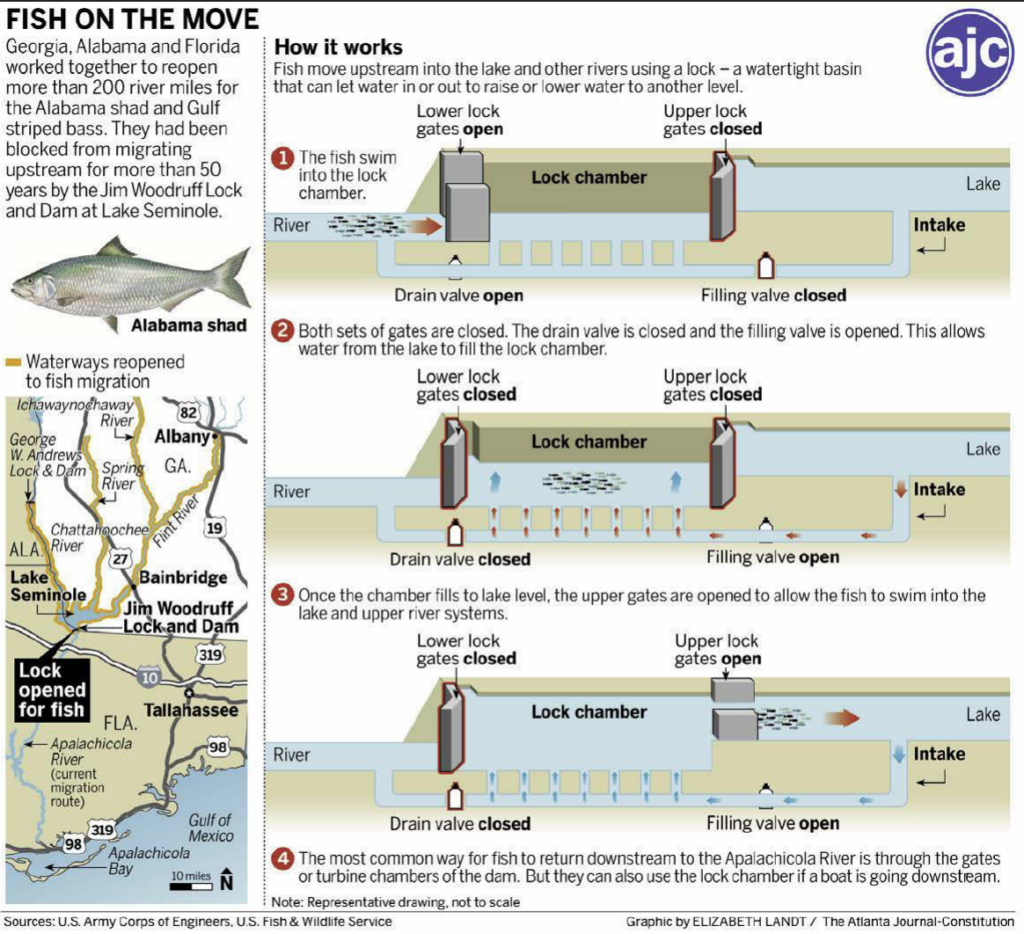
The Jim Woodruff Lock and Dam (JWLD) was built just below the confluence of the Chattahoochee and Flint Rivers, forming Lake Seminole at the Georgia-Florida state line. The JWLD was completed in 1957 by the US Army Corps of Engineers (USACE) for the purpose of navigation, power generation, and recreation. Navigation through the dam is completed using the lock which acts as an elevator, raising or lowering the water level inside the lock depending on which direction a ship is traveling.

In the early 2000s, researchers tested whether the existing navigation lock on the dam could be used as a fish passage tool for the blocked Alabama Shad population. This study found that tagged fish could successfully and voluntarily pass through the lock and continue upstream, demonstrating a conservation locking program (Young et al. 2012). Conservation locking continued at JWLD through 2017 which seemed to aid Alabama Shad population increases (GADNR unpublished monitoring data 2007-2023). Notably, a study showed that conservation locking operations during this period resulted in 85% of adults returning to the ACF Basin to spawn having natal origins in the Flint River (Schaffler et al. 2014). This indicated that the Flint may have better spawning habitats for this species than the other streams that feed into the reservoir, suggesting the Lower Flint River is an especially important region for shad conservation. Unfortunately, a conservation locking program did not occur from 2017-2025 for a variety of reasons, including recent maintenance on the locks themselves, leading to population declines in this system and increased evidence for the petitioning of Alabama Shad to be listed under the ESA (NMFS 2024). However, maintenance on the lock was completed in 2025, prompting numerous researchers and agencies to become interested in reestablishing conservation locking and subsequent monitoring for migratory species, specifically the Alabama Shad, in the ACF Basin.
Beginning in late 2025, the Jones Center team joined forces with colleagues from the Georgia Department of Natural Resources (GADNR), U.S. Fish and Wildlife Service, USACE, U.S. Geological Survey, and the University of Georgia’s Warnell School of Forestry and Natural Resources to collaborate on a pilot study on migratory fishes in the ACF Basin. We implemented a novel monitoring approach to further understand the success of conservation locking and future conservation of Alabama Shad in the ACF Basin.
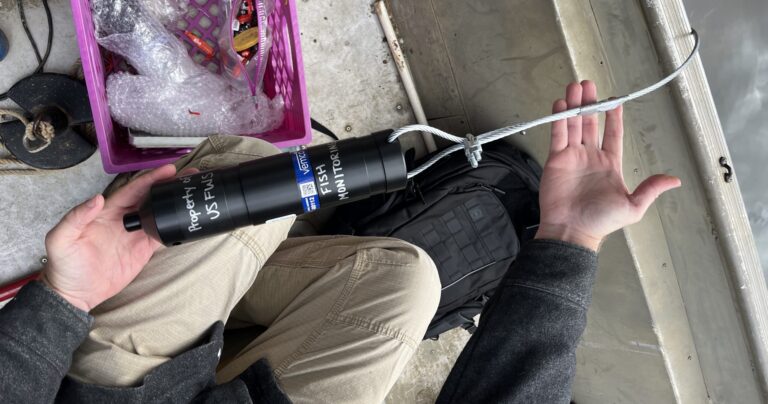
First, we evaluated if current acoustic telemetry technology works to remotely study Alabama Shad in the Lower Flint River. Acoustic monitoring uses receivers that are deployed underwater at fixed locations in the river. These receivers detect fish that have been implanted with unique acoustic transmitters as they swim by. This type of remote sensing negates the need to manually search via boat for tagged fish, thus allowing greater spatial coverage of migration extent and potential spawning habitat than prior Alabama Shad studies in the ACF Basin had been able to accomplish with manual telemetry tracking (Kern et al. 2017). However, we needed to know if acoustic telemetry, which relies on soundwaves being able to travel through the water from fish to receiver, would even be effective in the very noisy, shoal-filled Flint River.
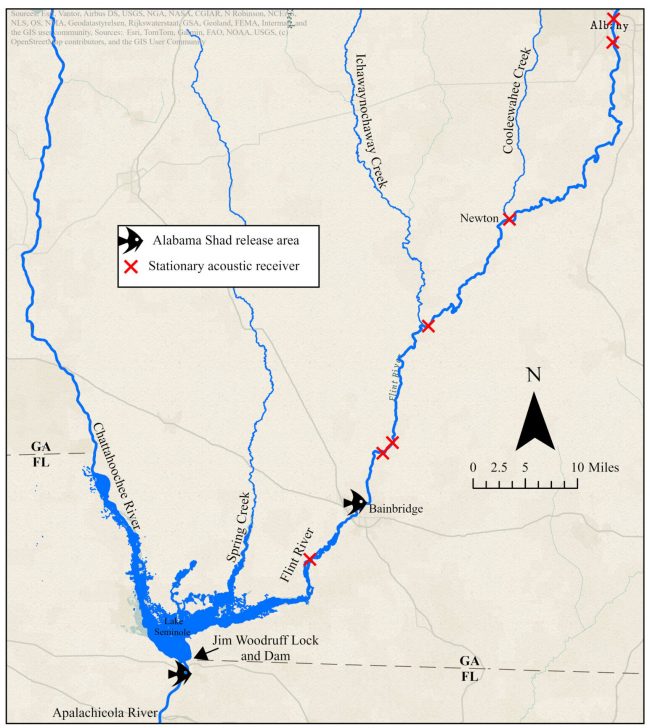
Thanks to shared resources between The Jones Center at Ichauway and our state and federal collaborators, Center staff deployed 7 acoustic receivers in February 2026 in the Lower Flint River between Bainbridge and Albany to test this technology. Eventually, our goal is to test the success of the repaired locks for allowing passage of Alabama Shad upstream. However, for this pilot study we decided to collect shad that had congregated below JWLD and transfer them around the dam to be tagged and released in Bainbridge along the Flint arm of Lake Seminole. This assisted migration allowed for a test of the efficacy of acoustic telemetry in Lower Flint. Five remaining shad were tagged and released below the dam.
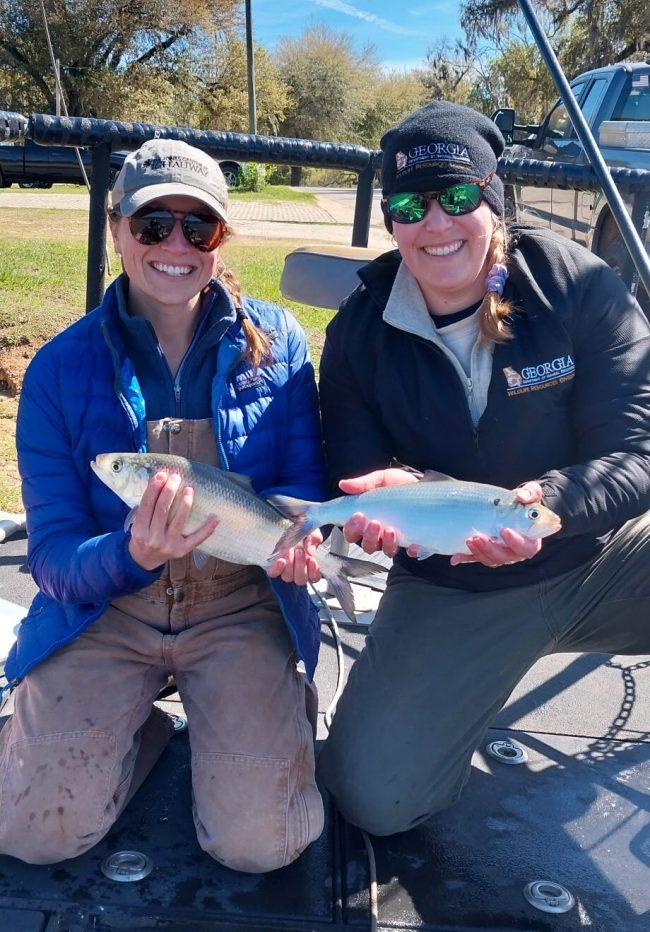
The tagging effort was led by GADNR fisheries biologists, with 18 male and 20 female adult Alabama Shad tagged between March and April 2026. To minimize handling time, acoustic transmitters were orally inserted into the stomachs of captured adults (Young et al. 2012). Alabama Shad feed little to none while in freshwater, relying on reserves of marine-derived fats during their freshwater spawning migration (Freeman and Weller 2009). This quirk of their life history allowed us to use such a minimally invasive method of tagging them with a fair chance of the transmitter not passing completely through their gut after being moved into the Flint. Transmitters had a battery life of around 3 months, giving us the chance to detect how far and when they moved upstream or downstream during their spawning period.
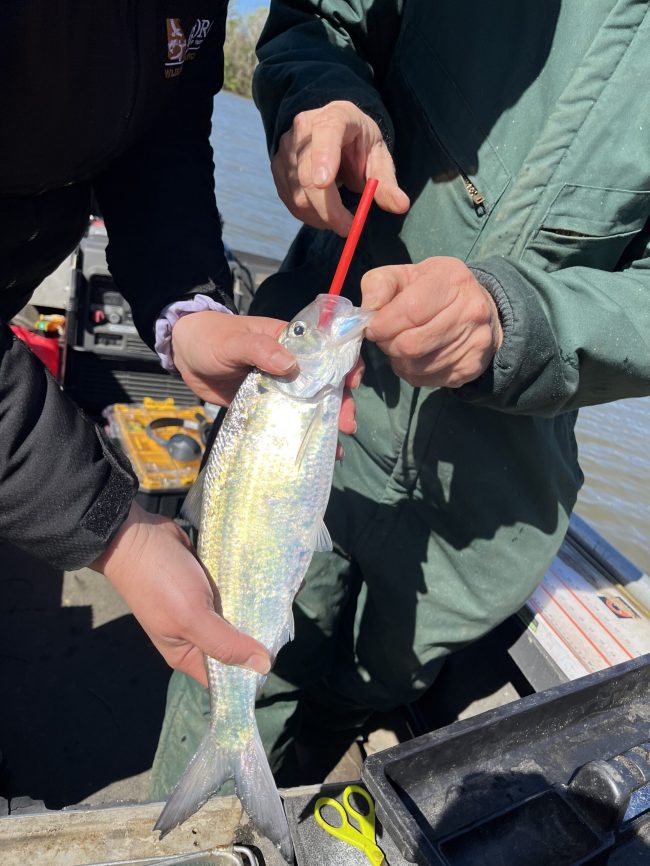
As of June 2026, receivers have detected 22 out of the original 38 tagged Alabama Shad via acoustic telemetry, heralding promise for future use of this technology in the Lower Flint River. Many of these fish congregated in one specific part of the river which may be indicative of important spawning habitat. Several shad were detected as far upstream as Newton, around 41 miles upstream of their release location! One female Alabama Shad moved between receivers that were 15 miles apart in just under 28 hours. Finally, two of the five shad that were released below the dam were successfully detected in Bainbridge the day after USACE began daily conservation locking activities. This confirmed once again that locking can be an effective conservation tool for this species and that at least a portion of the ACF Basin Alabama Shad population migrates into the Flint River when given the opportunity.
In addition to the movement study, GADNR biologists tested methods to collect Alabama Shad eggs to further study the timing and location of spawning in the Flint River. Alabama Shad are broadcast spawners: eggs are fertilized in the water column and drift downstream to settle on the riverbed, developing into fry over the course of about a week (Boschung and Mayden 2004). To attempt to collect these eggs, biologists towed a very fine mesh net called an ichthyoplankton tow below a boat throughout different parts of the river over the course of many weeks. Sorting through these samples to find individual fish eggs is very tedious and time-consuming; however, they have successfully identified at least 8 Alabama Shad eggs. Future work by our team will be aimed at identifying the development stage of each egg, then back-calculating how far it has drifted since being broadcast using, stream flow data from the USGS to ultimately identify the location of spawning areas.

The success of this pilot study sets us and our collaborators up for continued Alabama Shad monitoring and future acoustic telemetry research in the lower ACF Basin. Our results are promising for the sustained success of conservation locking by the USACE. Future telemetry research efforts will focus on learning how to optimize the schedule of conservation locking and further understand the extent of Alabama Shad habitat use in the basin. Additionally, the success of such collaborative work and proof of the efficacy of acoustic telemetry could lead to the establishment of a broader acoustic monitoring network in the ACF Basin. This type of network could be used not just for monitoring Alabama Shad movements but also for other imperiled aquatic taxa such as Gulf Sturgeon (Acipenser oxyrinchus desotoi) or Alligator Snapping Turtle (Macrochelys temminckii). We look forward to continued cooperation with our state, federal, and nonprofit partners on this migratory species and others, knowing that this kind of basin-wide, multi-state conservation project wouldn’t be possible without engaged and collaborative partners.
Boschung, H.T. & Mayden, R.L. (2004). Fishes of Alabama. Smithsonian Books.
Center for Biological Diversity. (2024, February 27). Petition to list the Alabama shad (Alosa alabamae) under the Endangered Species Act as an endangered or threatened species and to concurrently designate critical habitat. Submitted to the U.S. Department of Commerce, NOAA Fisheries.
Freeman, B.J. & Weller, R. (2009). Species profile for Alosa alabamae. Georgia Biodiversity Portal, Wildlife Resources Division, Wildlife Conservation Section, Social Circle. https://georgiabiodiversity.org/portal/profile?group=all&es_id=19665
Kern, A. I., Sammons, S. M., & Ingram, T. R. (2017). Habitat Use by Telemetered Alabama Shad During the Spawning Migration in the Lower Flint River, Georgia. Marine and Coastal Fisheries, 9(1), 320-329. https://doi.org/10.1080/19425120.2017.1327906
Mettee, M. F. & P. E. O’Neil. 2003. Status of Alabama Shad and Skipjack Herring in Gulf of Mexico drainages. pp. 157-170 In: K. E. Limburg and J. R. Waldman, Editors. Biodiversity, status, and conservation of the world’s shads. American Fisheries Society. Symposium 35.
National Marine Fisheries Service. (2024). Endangered and threatened wildlife; 90-day finding on a petition to list the Alabama shad as threatened or endangered under the Endangered Species Act. Federal Register, 89, 59881–59888. https://www.federalregister.gov/documents/2024/07/24/2024-16253/endangered-and-threatened-wildlife-90-day-finding-on-a-petition-to-list-the-alabama-shad-as
Rider, S. J., Powell, T. R., Dattilo, J. E., & Miles, G. T. (2021). Status and relative abundance of Alabama Shad, Alosa alabamae, in Alabama. Southeastern Fishes Council Proceedings, 1(61).
Schaffler, J. J., Young, S. P., Herrington, S., Ingram, T., & Tannehill, J. (2014). Otolith Chemistry to Determine Within‐River Origins of Alabama Shad in the Apalachicola–Chattahoochee–Flint River Basin. Transactions of the American Fisheries Society, 144(1), 1-10. https://doi.org/10.1080/00028487.2014.954056
U.S. Fish and Wildlife Service. Species profile: Alabama shad (Alosa alabamae). Environmental Conservation Online System. Retrieved July 1, 2026, from https://ecos.fws.gov/ecp/species/10482
Young, S. P., Ingram, T. R., Tannehill, J. E., & Isely, J. J. (2012). Passage of Spawning Alabama Shad at Jim Woodruff Lock and Dam, Apalachicola River, Florida. Transactions of the American Fisheries Society, 141(4), 881-889. https://doi.org/10.1080/00028487.2012.675917