
Natural Resources Research & Management
Natural Resources Research & Management
Ecologists have long recognized the importance of natural disturbances, such as fire, in shaping wildlife communities, but the ecological role of wind disturbance is much less understood. Many factors, including storm extent, intensity, and duration, as well as forest type and structure, can influence the impact that forests sustain from wind. While many studies focus on the effects of wind at larger scales, there has been very little reported on small-scale disturbances, such as individual treefalls.
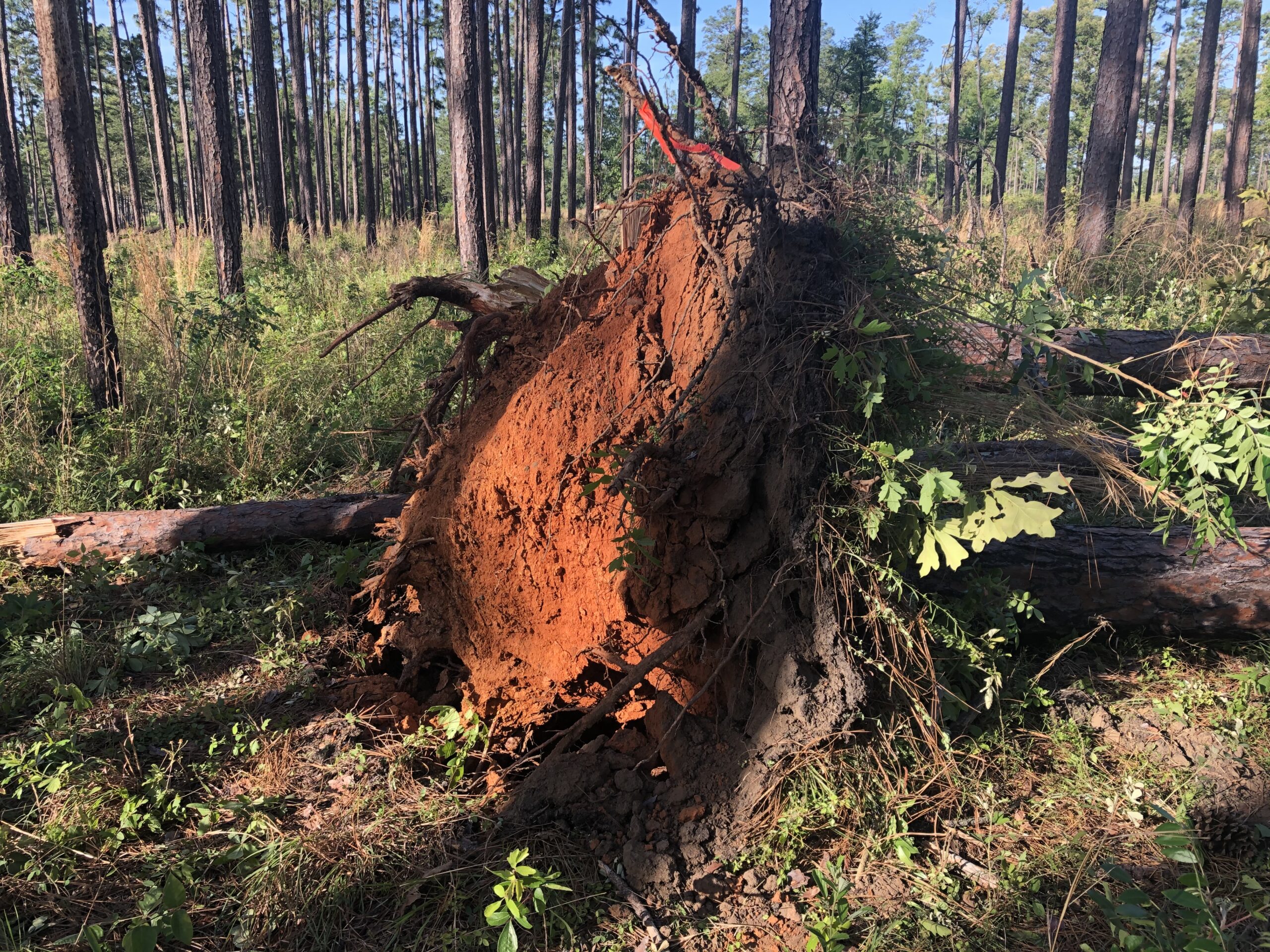
Treefall from wind disturbance is relatively commonplace in many forests of the coastal eastern U.S., with much of the Gulf Coastal Plain experiencing tropical cyclones roughly every 6 years. Uprooted trees blown over from wind events create a unique microsite structure, with a tree bole, root plate or mound, and pit that may form habitat for some wildlife species.
We used static winching methods to topple 9 live longleaf pine (Pinus palustris) trees to simulate wind disturbance and monitored tip-ups monthly from May through December 2021 using camera traps. We investigated how vertebrates use newly uprooted longleaf pine tree tip-ups and examined how patterns of use varied with time and tree characteristics.
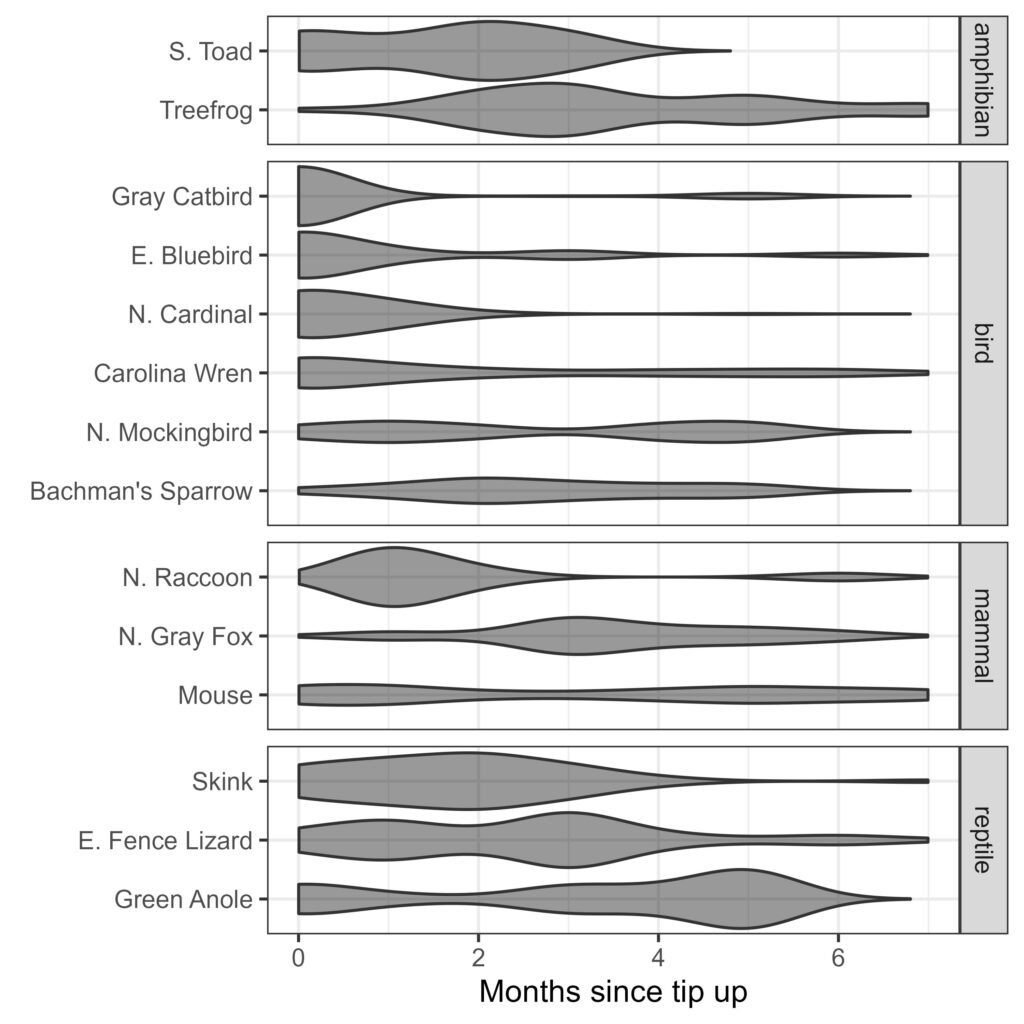
We identified 48 unique taxa using tip-ups, with the greatest species richness among birds (n = 17 species), followed by reptiles (n = 14 species), and amphibians (n = 4 species). We found that wildlife tip-up use varied through time, forming a progression dominated in the early stages by birds and lizards, and later by amphibians and mesomammals. We also found that vertebrate species partitioned use by occupying distinct microhabitats within tip-up pit-and-mound topography and diel activity.
We demonstrated that tree tip-ups provide habitat for many vertebrate species and may therefore be an important consideration for retention to preserve their ecological contributions. Additionally, retention of tree tip-ups in longleaf pine forests may also be important for the conservation of imperiled species detected in our study, including Bachman’s sparrow, northern bobwhite, eastern diamondback rattlesnake, and the gopher tortoise.
Howze, J.M., Cannon, J.B., Smith, L.L. 2025. Fine-scale effects of simulated wind disturbance: Vertebrate use of uprooted pine treefalls. Journal of Wildlife Management e70142. doi.org/10.1002/jwmg.70142
Jen Howze, jennifer.howze@jonesctr.org
Jeffery Cannon, jeffery.cannon@jonesctr.org
Lora Smith, lora.smith@jonesctr.org
Ecologists have long recognized the importance of natural disturbances, such as fire, in shaping wildlife communities, but the ecological role of wind disturbance is much less understood. Many factors, including storm extent, intensity, and duration, as well as forest type and structure, can influence the impact that forests sustain from wind. While many studies focus on the effects of wind at larger scales, there has been very little reported on small-scale disturbances, such as individual treefalls.
Treefall from wind disturbance is relatively commonplace in many forests of the coastal eastern U.S., with much of the Gulf Coastal Plain experiencing tropical cyclones roughly every 6 years. Uprooted trees blown over from wind events create a unique microsite structure, with a tree bole, root plate or mound, and pit that may form habitat for some wildlife species.
We used static winching methods to topple 9 live longleaf pine (Pinus palustris) trees to simulate wind disturbance and monitored tip-ups monthly from May through December 2021 using camera traps. We investigated how vertebrates use newly uprooted longleaf pine tree tip-ups and examined how patterns of use varied with time and tree characteristics.
We identified 48 unique taxa using tip-ups, with the greatest species richness among birds (n = 17 species), followed by reptiles (n = 14 species), and amphibians (n = 4 species). We found that wildlife tip-up use varied through time, forming a progression dominated in the early stages by birds and lizards, and later by amphibians and mesomammals. We also found that vertebrate species partitioned use by occupying distinct microhabitats within tip-up pit-and-mound topography and diel activity.
We demonstrated that tree tip-ups provide habitat for many vertebrate species and may therefore be an important consideration for retention to preserve their ecological contributions. Additionally, retention of tree tip-ups in longleaf pine forests may also be important for the conservation of imperiled species detected in our study, including Bachman’s sparrow, northern bobwhite, eastern diamondback rattlesnake, and the gopher tortoise.
Howze, J.M., Cannon, J.B., Smith, L.L. 2025. Fine-scale effects of simulated wind disturbance: Vertebrate use of uprooted pine treefalls. Journal of Wildlife Management e70142. doi.org/10.1002/jwmg.70142
Jen Howze, jennifer.howze@jonesctr.org
Jeffery Cannon, jeffery.cannon@jonesctr.org
Lora Smith, lora.smith@jonesctr.org