
Natural Resources Research & Management
Natural Resources Research & Management
Crown scorch is the heat-induced browning of tree canopies. In ecosystems that are managed with frequent fire, crown scorch is consistently one of the strongest predictors of post-fire tree mortality. Yet reliably measuring scorch remains a persistent challenge. Longleaf pine is well adapted to frequent burning through traits like a fire-resistant grass stage and thick bark; however, mature trees are not invulnerable to fire. Intense burns can scorch tree canopies, and this injury may ultimately lead to mortality, with implications for ecological restoration and timber management.
The standard approach for measuring crown scorch involves two trained observers visually examining each tree and reaching a consensus scorch percentage. This method has changed little in decades and is slow, subjective, and difficult to deploy at large scales.
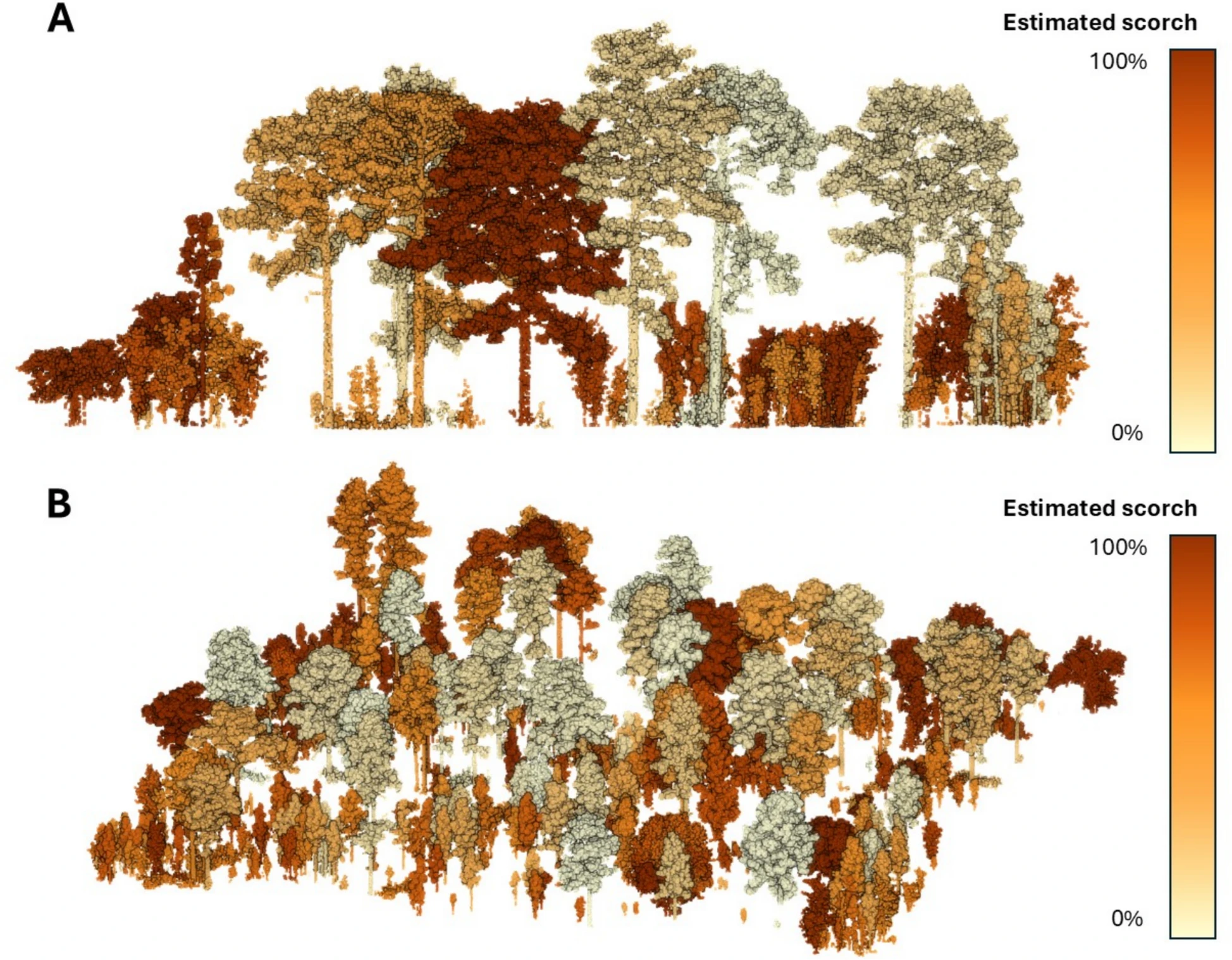
Terrestrial lidar scanning (TLS) is a technology that is gaining widespread application in forestry contexts that offers a promising alternative. TLS emits millions of infrared laser pulses to capture three-dimensional representations of forests. We hypothesized that TLS intensity values differ between intact and scorched tree crowns and provide objective measurements of crown scorch that increase the speed and scale at which it can be measured.
To test this hypothesis, we scanned more than 250 longleaf pines after a growing season burn, spanning the full scorch range. Machine learning models trained on TLS data predicted crown scorch with high accuracy, especially for large trees, and completed measurements roughly 20 times faster than visual methods.
We released open software (CrownScorchTLS) so that researchers and managers can apply our approach to measure scorch in other forest types and with other TLS sensors. With prescribed fire expanding across restoration landscapes, scalable and objective scorch measurement finally gives fire ecologists the tools to link fire behavior to tree survival.
Jeffery Cannon, jeffery.cannon@jonesctr.org
Cannon, J.B., N.E. Zampieri, A.W. Whelan, T.M. Shearman, A.J. Sánchez Meador, and J.M. Varner. 2025. Terrestrial lidar scanning provides efficient measurements of fire-caused crown scorch in Longleaf Pine. Fire Ecology 21(1): 71. doi.org/10.1186/s42408-025-00420-0.
Crown scorch is the heat-induced browning of tree canopies. In ecosystems that are managed with frequent fire, crown scorch is consistently one of the strongest predictors of post-fire tree mortality. Yet reliably measuring scorch remains a persistent challenge. Longleaf pine is well adapted to frequent burning through traits like a fire-resistant grass stage and thick bark; however, mature trees are not invulnerable to fire. Intense burns can scorch tree canopies, and this injury may ultimately lead to mortality, with implications for ecological restoration and timber management.
The standard approach for measuring crown scorch involves two trained observers visually examining each tree and reaching a consensus scorch percentage. This method has changed little in decades and is slow, subjective, and difficult to deploy at large scales.
Terrestrial lidar scanning (TLS) is a technology that is gaining widespread application in forestry contexts that offers a promising alternative. TLS emits millions of infrared laser pulses to capture three-dimensional representations of forests. We hypothesized that TLS intensity values differ between intact and scorched tree crowns and provide objective measurements of crown scorch that increase the speed and scale at which it can be measured.
To test this hypothesis, we scanned more than 250 longleaf pines after a growing season burn, spanning the full scorch range. Machine learning models trained on TLS data predicted crown scorch with high accuracy, especially for large trees, and completed measurements roughly 20 times faster than visual methods.
We released open software (CrownScorchTLS) so that researchers and managers can apply our approach to measure scorch in other forest types and with other TLS sensors. With prescribed fire expanding across restoration landscapes, scalable and objective scorch measurement finally gives fire ecologists the tools to link fire behavior to tree survival.
Jeffery Cannon, jeffery.cannon@jonesctr.org
Cannon, J.B., N.E. Zampieri, A.W. Whelan, T.M. Shearman, A.J. Sánchez Meador, and J.M. Varner. 2025. Terrestrial lidar scanning provides efficient measurements of fire-caused crown scorch in Longleaf Pine. Fire Ecology 21(1): 71. doi.org/10.1186/s42408-025-00420-0.